Search This Blog

MyFreeCopyright.com Registered & Protected
Showing posts with label Rights and Freedoms. Show all posts

Saturday, December 24, 2011

Jamaica's Reaction to Statement By Portia Simpson Miller X

The following are letters to the editor, published in the Jamaican Gleaner

Shame On JLP For Mockery

THE EDITOR, Sir:

Why have I finally decided to vote for Portia Simpson Miller? Spiritually good people don't belittle others. Bad people do.

If the Jamaica Labour Party displayed a good spirit to others, they wouldn't be belittling anyone, especially a lady of our soil, culture, race and creed. I am really ashamed of the JLP's approach.

Portia Simpson Miller is being herself and being a good person. God doesn't love the criticism and He encourages us to walk in His footsteps.

This is why I cannot vote for a party that belittles anyone that resembles me.

H. MILLER

thetruthspeak@ovi.com

Issue:Keeping Out The Gays?
Homosexuals are people too

THE EDITOR, Sir:

Many Jamaicans are oblivious of the laws that prohibit homosexuals the rights that characterise them as human beings.

Most of you do not think about your rights, and they are frequently taken for granted. Also, numerous people have preconceived notions of how homosexuals behave. Attitudes toward homosexuality are overwhelmingly negative.

All I ask of you is to look around. Homosexuality is part of society. People, such as your neighbour, hairdresser, relatives, friends, and people you have known all your life, could be gay! Does that make them different?

Many people say that homosexuality is not natural. But I ask you, what is natural? They are a component of society, and we must grant them equal rights. Homosexuals face religious criticism and social injustice every day of their lives. So for the prime minister to be saying that his sentiment must be guided by the sentiment of Jamaica, that, essentially, is homophobic.

Some aspects of human identity are so fundamental that they should be left to each individual, free of all non-essential regulation, even when manifested in conduct. An individual should not be penalised personally or prohibited socially from enjoying basic rights and freedoms because of sexual orientation or the country he/she is from unless that person's behaviour inflicts harm on other people.

Government should provide basic rights, freedom, and justice to every person without regard to an individual's sexual orientation. Governments should offer to all citizens the civic rituals and arrangements that are offered to any citizen.

ALEX M. LODGE

alexlodge1992@yahoo.com

Friday, December 23, 2011

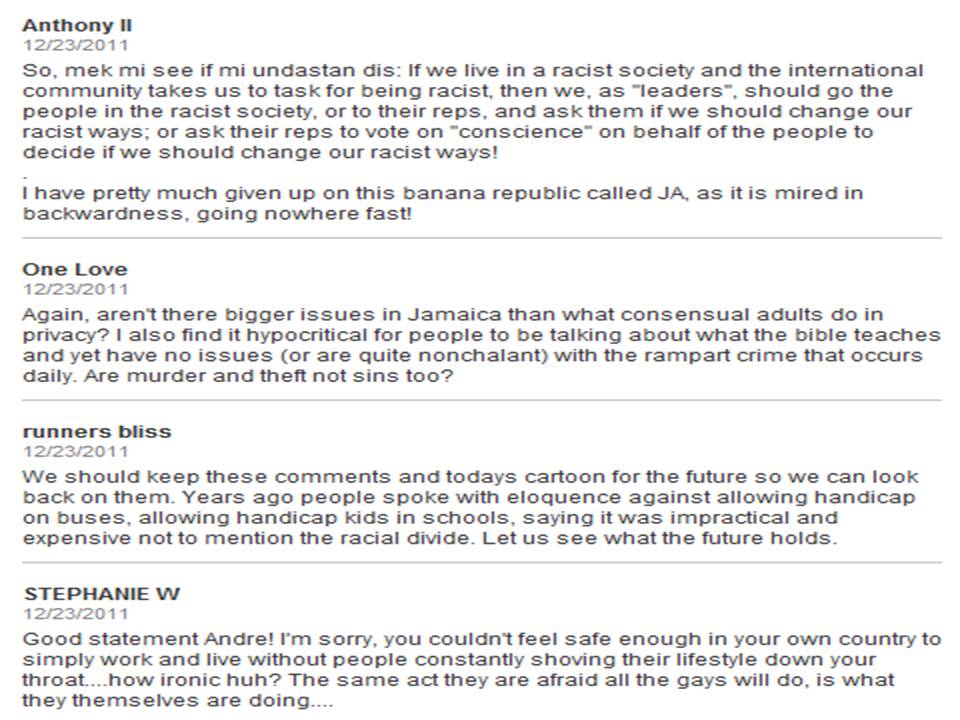
Church angry, gays happy Comments [Pictures]


Jamaica's Reaction to Statement By Portia Simpson Miller Part VIII

I think I missed the memo that Jamaica had become a theocracy. The following was taken from the Jamaica Observer. 
Church angry, gays happy
PNP on collision course with Christians
THE perennially controversial issue of homosexuality appears to have set the Opposition People’s National Party (PNP) on collision course with some sections of the Christian Church.
PNP Leader Portia Simpson Miller shocked the television audience watching her debate with Prime Minister Andrew Holness Tuesday night, with her suggestion that the buggery law should be reviewed and that she was not opposed to having gays in a Cabinet led by her.
MILLER… it is saying that moral values become secondary to ability to perform
 1/4 

“That is very concerning for me [reviewing the buggery law] and I am disappointed that we are still insisting to go back in that direction, because the matter was dealt with in the amended Bill of Rights earlier this year,” said Rev Al Miller, pastor of the Fellowship Tabernacle in Kingston.
Miller said he was equally disappointed with the Opposition Leader’s stance that she had no problem admitting anyone to her Cabinet once they were qualified to carry out their duties.
“I am seriously concerned about that, because it is saying that moral values becomes secondary to ability to perform,” the pastor said, adding: “That kind of approach would be difficult for Christians to support because character and integrity takes precedence over ability.”
Associate pastor of the Tower Hill Missionary Church, Rev Mark Dawes also took offence at Simpson Miller’s stance: “If we remove the buggery law, then we might be opening the floodgate for sexual anarchy,” he cautioned.
He said, however, that he understood her belief that no one should be prevented from being apart of a Cabinet once they were qualified to do so, even if they subscribed to the gay lifestyle.
“If the person is not promoting that lifestyle, then I could grow to be comfortable with them in the Cabinet, but if it is somebody who is championing the lifestyle and advocating for it, then I’ll have a problem,” Dawes said.
In the debate, Simpson Miller said: “We should have a look at the buggery law,” distancing herself from Former Prime Minister Bruce Golding who told a British Broadcasting Corporation (BBC) interviewer he would not allow a homosexual in his Cabinet.
The Seventh-day Adventists also rejected the call to revisit the buggery law, while saying they had no problem with gays in a Cabinet.
“The issue is with reviewing the law, that’s where the church has an issue. Like any other faith-based organisation, we are concerned because it goes against the biblical side of things,” said SDA director of communication, public affairs and religious liberty, Nigel Coke.
But general secretary of the Jamaica Baptist Union, Rev Karl Johnson commended Simpson Miller for tackling the issue head on when asked by a journalist in the debate. Reviewing the law did not necessarily mean that a change would occur, Johnson argued.
“I think it is a commendable thing to always review our laws to see whether they speak to current realities, whether they are still informed by values and norms that we can sustain both as a country and I would say as a religious community,” he said.
President of the Jamaica Association of Full Gospel Churches, Bishop Rohan Edwards said he believed that a review of the buggery act would not affect the way the church viewed the homosexual lifestyle.
“We don't have a problem with the revisiting buggery law, but we know the law that we have to answer to which is the word of God. So they have the right to revisit anything they want to,” he said.
For its part, the Jamaica Forum for Lesbians, All-Sexuals and Gays (JFLAG) welcomed Simpson Miller’s position. Executive director of the lobby group, Dane Lewis, said: “We are very encouraged by the statement, it was a very bold statement by a political leader knowing the history of statements which our leaders have made and so we look forward to seeing what is to come if they certainly do form the next government.
“It really speaks loudly to a respect for the human rights of all Jamaicans, including those who are gay, lesbian, bi-sexual or transgender,” he noted.
He said he was disappointed with the response given by Holness who was very cautious in his response when he stated that his “sentiment must be the sentiment of the country”.
“We are disappointed that the prime minister, even though he had another opportunity to make certainly a bold statement, he didn’t,” he said. “It is very clear that he is going to pander to the religious community and vaguely step around the issue,” Lewis asserted.

Idiot plan that-Many Jamaicans Buggery Law Review Comments [Pictures]


Jamaica's Reaction to Statement By Portia Simpson Miller Part II

I've been trying to decide how to keep my readers up to speed with what is happening following Portia Simpson Miller's [personal] statement that gays can serve in her cabinet (read it here: Simpson Miller Gays can serve in my cabinet (Jamaica Election Debates 2011- Leadership ). I've decided that until I sit and put my thoughts together I'll keep you updated by reposting news articles, other blogs, videos, and comments (Jamaica's Reaction to Statement By Portia Simpson Miller (Gays can serve in my cabinet) Pt I).

So let's get started.

The following was taken from the Jamaica Observer.


‘Idiot plan that!’ - Many Jamaicans against Buggery Law Review
THE pronouncement by Opposition Leader and People’s National Party (PNP) President Portia Simpson Miller during Tuesday night’s national leadership debate that a PNP government led by her would review the buggery law has set off a heated debate with many Jamaicans as well as some churches voicing strong opposition to any such move.
Observer staff reporter Kimmo Matthews yesterday sought the opinions of members of the public on Simpson Miller’s position.
(L-R) ‘Rastaman’, Judith Brown White and Chevan Brown
 1/3 

‘Rastaman’
It is something that I would have to go think about, as I do not want to jump to any conclusion on what was said.
Judith Brown White: Supermarket Sales Rep
I have a problem with that decision. To carry out such a review is totally wrong. What it is promoting is totally against the teachings of the Bible.
Chevan Brown
I think it was a ploy to get votes.
Delroy Mitchell
It has been happening, not here in Jamaica only, and soon or later we are going to have to take a stance. I believe that the rights of citizens should be recognised.
Devon Campbell: Taxi Operator
Not in my cabinet! If a man a deal with him thing, mek him deal with it one side. So that means sooner or later, with this review of the law, my grandchildren can’t walk in peace.
Hubert Palmer: Security guard
We are to stop trying to put a pretty coating on the issue. That sort of practice should not be tolerated. What sort of message will that send to my little son down the road?
Chairmaine Mundle: Supermarket Sales Rep
That should never be allowed to happen. God has never created people to operate and entertain that sort of practice. Our country has a strong Christian faith and belief and that sort of practice should not be encouraged and that is what such a planned review will do.
‘Businesswoman’
Our source is God. Why are we trying to sell our souls for the almighty dollar? Jamaica is not a country that embraces that sort of practice. She is out of her cotton-picking mind and she should not sell her soul for the dollar.
Ian
It is full time we should try to move away from that sort of primitive approach and allow people to live their lives despite of their sexual orientation.
Richardo Wedderburn: Security Guard
She should have tried to come up with some different approach. I know because she is a woman she a go try balance the thing. But I believe a revision of such laws is going to affect us down the road.
Jonelle Jefferson: Secretary
I do not care what a man or woman wants to do with their life, but the Opposition needs to realise that it is Jamaica we are living in and we are not going to change our views and I think it is going to hurt her chances in the upcoming election.
Orlando Gayle: Security Guard
That is totally unacceptable. Such practice and support of such practice cannot be right at all. We burn that sort of practice. Her move or plans to review the law will certainly help to promote such practice.
Toney Bromwell: Taxi Operator
Idiot plan that. Jamaica no deal with that. A vote me feel she a look.


Read more: http://www.jamaicaobserver.com/news/Many-Jamaicans-against-Buggery-Law-review_10447168#ixzz1hNcbo3dI

Saturday, December 17, 2011

A Rebuttal of the Foolishness Touted at the Lawyers Christian Fellowship symposium

The following article was written by an attendee at the Lawyers Christian Fellowship symposium on Saturday December 10 (2011) under the title Human Rights, Sovereignty and the Politics of Truth at the University of the West Indies Faculty of Law . The individual has asked me to publish the article under my name, for the sake of their safety.
************************************************************************

The first few words of the Universal Declaration of Human Rights establishes the basic premise of international human rights law, it says; “All human beings are born free and equal in dignity and rights”. Article 2 goes on to say “Everyone is entitled to all the rights and freedoms set forth in this Declaration, without distinction of any kind, such as race, colour, sex, language, religion, political or other opinion, national or social origin, property, birth or other status...” Yet having attended a symposium put on by the Lawyers Christian Fellowship (LCF)and the Issachar Foundation, it is very clear that they would like nothing better than to limit the scope of availability of human rights to non-Christians, and people who do agree with their ideology.

The presenters at the symposium, were Shirley Richards, co-founder of the Lawyers Christian Fellowship; Piero Tozzi, legal counsel for the US Christian lobbying group, Alliance Defense Fund; and Paul Diamond, a UK barrister who specializes in religious liberties cases, Rev. Clinton Chisholm and Dr. Wayne West.

From left to right: Clinton Chisholm, Shirley Richards, Piero Tozzi, Paul Diamond


The basis, it seems, for the Christian Right’s attempt to limit the rights afforded to homosexuals, is that homosexuality is a choice. If we work on that premise, then where is the justification for protection of Christianity, or for laws that follow the Christian religion? Is religion not a matter of choice? The act of becoming a Christian begins first with a choice. One chooses to believe in a particular religion, and one chooses to continually believe in a religion or faith.

It has been argued by those in the Christian right, that the major document on human rights, to which Jamaica is a signatory, the Universal Declaration of Human Rights (UDHR) does not explicitly state non-discrimination on grounds of sexual orientation and as such there is no need to protect non-heterosexuals under the law. This argument can be rebutted by taking a quick look at the Office of the High Commissioner for Human Rights, it states under ‘Combating discrimination based on sexual orientation and gender identity’, that:

While the Universal Declaration of Human Rights and United Nations human rights treaties do not explicitly mention “sexual orientation” or “gender identity”, they do establish an obligation on the part of States to protect people from discrimination, including on the basis of “sex … or other status.” UN treaty bodies, whose role is to monitor and support States’ compliance with treaty obligations, have issued a series of decisions or general comments all confirming that such language is sufficiently broad as to encompass “sexual orientation,” effectively establishing sexual orientation as a prohibited ground of discrimination under relevant human rights treaties. This view has also been endorsed by 17 special procedures (independent experts appointed by the Human Rights Council to monitor and report on various human rights issues), as well as by the UN High Commissioner for Human Rights and the UN Secretary-General.

The fear mongering tactic adopted by the Christian and Religious Right would like us to believe, as was so cleverly insinuated by Paul Diamond at the above mentioned symposium, is that by protecting people of all sexual orientations, the rights of others will be trumped. Rather, it seems to me that what the Christian right is trying to tell us is that their rights are special rights and their ideology (which is a choice) deserves a special place in the laws of the land. You see, right now the issue is about homosexuality and whether these persons deserve protection under the law, and whether sections 76, and 77 of the Offences Against the Person Act (2006) should be repealed. Do not be fooled, however, because there is a Christian Right agenda (oh yes), it is an agenda to see all laws, and customs reflect Christian ideology. It’s an agenda, to get rid of dissenters, to get rid of non-Christians (see Christian Dominionism and Reconstructionism below).

Human rights and non-discrimination does not operate in a vacuum, the violations of the rights of people of different sexual orientations are not the only violations which occur and which are condemned, which the panel at the symposium seemed to want us to believe. After all Paul Diamond when asked (by Maurice Tomlinson) whether he thought the murder of 16-year-old Oshane Gordon on October 18 "due to questionable relations with another man" was a result of the existence of Jamaica's anti-sodomy law, responded "That's a stupid question as the most persecuted group in the world are Christians" (Tomlinson’s Blog at Aids-Free World), the panel went on to accuse the UN of not protecting the rights of Christians. I guess they ignore the UN’s statement on discrimination on religion or belief, since it doesn’t speak solely of Christianity. After-all, the UN recognises that:

In their everyday life, many members of religious or belief communities face discrimination based on their religion or belief. They are unduly restricted in the enjoyment of their civil, cultural, economic, political and social rights. As such, members of certain religious or belief communities suffer discrimination in their access to public education, health services or public posts. In extreme cases, some of them are also arrested or killed due to their religious affiliation. 

The United Nations has been concerned with this issue since its foundation and the prohibition of religious discrimination is enshrined in all core international human rights treaties. 

There is also recognition of discrimination against women and the UN also works to combat discrimination against women, women are –in my opinion- among the most discriminated population in the world, coming from the historical (religious, and culturally influenced) view of women as second class citizens and less than men. The UN on their website states:

Women form the majority of the world’s poorest people and the number of women living in rural poverty has increased by 50% since 1975. Women work two-thirds of the world’s working hours and produce half of the world’s food, yet they earn only 10% of the world’s income and own less than 1% of the world’s property. Violence against women throughout the world and in all cultures prevails on an unimaginable scale, and women’s access to justice is often paired with discriminatory obstacles – in law as well as in practice. Multiple forms of discrimination based on gender and other factors such as race, ethnicity, caste, disability, persons affected by HIV/AIDS, sexual orientation or gender identity further compounds the risk of economic hardship, exclusion and violence against women.

It is hypocrisy and a shame that Jamaica stands on the world stage and lies about a documented policy to protect women, girls and homosexuals, when no such policy exists, that “Jamaica does not condone discrimination on the grounds of sexual orientation”, and that “there is no legal discrimination on the grounds of sexual orientation”.  Further-more on the Ministry of Justice’s website site, under Human Rights it is written:

Jamaica continues to stand in solidarity with other nations in its commitment to respect and preserve human rights as demonstrated by the fact that Jamaica is a party to the major international conventions concerning the protection of human rights, including the International Covenant on Civil and Political Rights, and Jamaica’s Constitution as well as other laws seek to protect and preserve basic human rights. This confirms Jamaica’s faith in fundamental rights, in the dignity and worth of the human person and in the equal rights of men and women. 

Surprisingly the Government states it recognises “that protection of the most vulnerable is of highest priority for Jamaica”, why is it then that the Government has allowed itself to be bullied into passing legislation that does not protect the rights of one of the most vulnerable groups?

The Ministry’s website states:

The Government of Jamaica remains committed to ensuring that it conforms to both the spirit and letter of the Universal Declaration of Human Rights and will continue to work with human rights organizations and individuals to raise awareness and ensure that the protection of human rights in Jamaica is guaranteed.

Shirley Richards in her presentation titled “The Role of Law in Society,” sought to provide ‘natural law’ justifications for the retention of the laws against sodomy and abortion. Maurice Tomlinson in his blog at Aids-Free World stated:

In this quest, she ignored modern jurisprudence and relied, for example, on the 3rd edition of a core criminal  law text now in its 12th edition, which defined a crime as an action which is “morally blameworthy; a sin.”

Natural law is defined as:

The unwritten body of universal moral principles that underlie the ethical and legal norms by which human conduct is sometimes evaluated and governed. (The Free Dictionary)

There are three types of natural law:

Divine natural law represents the system of principles believed to have been revealed or inspired by God or some other supreme and supernatural being. These divine principles are typically reflected by authoritative religious writings such as Scripture. Secular natural law represents the system of principles derived from the physical, biological, and behavioural laws of nature as perceived by the human intellect and elaborated through reason. Historical natural law represents the system of principles that has evolved over time through the slow accretion of custom, tradition, and experience. (The Free Dictionary)

In their argument against the protection of homosexuals; proponents of natural law believe that nature endows humans with reason, and all you have to do is consult that reason to know that homosexuality is morally wrong. There are at least two problems with natural law as highlighted by Nathaniel Frank in Gay Rights and the Natural Law Farce:

First is that it is utterly circular: it relies on broad agreement about what is a human good, from which natural law theorists deduce morally right action as anything that leads to that good; but how do we decide in the first place what is a moral good? Conservatives might posit that human goods include procreation or religion, while liberals might include tolerance, pleasure, or equality. That this latter good was Thomas Jefferson's top "self-evident" good when he wrote our founding natural law document, the Declaration of Independence, does not seem to convince conservatives like [Robert] George that gay people should be included in the enjoyment of equality. Most of us may agree on friendship or knowledge as human goods, but the test of a good theory is whether it's applicable when the tougher stuff comes into play. Natural law fails this test, as it's totally incapable of actually answering the question of how nature or reason resolves the question of what is morally good.

The second problem is that the link that natural law makes between observation and valuation relies on privileging one natural act over another as your starting point, and insisting that act is supreme, to the exclusion of other acts that some view as good. Those like Freud and [Robert] George, who apparently view the world through a telling prism of sexual fixation, choose the procreative act as supreme. They reason that this act is central to the "biological good of the whole," as [Robert] George puts it, and is therefore morally good for individuals to engage in. (Of course, it's only deemed moral if you're married, and while I don't have room to address this here, note that conservatives use a bait-and-switch to toggle sloppily between marriage and sex, which really must not be used interchangeably.) The trouble is that urinating is also central to the biological good of the whole, because if we didn't eliminate waste, we'd all perish. But we don't hear much about this in natural law. Instead, we hear that the penis was naturally designed for procreation, so the only morally proper use of it is an act that leads to procreation (or resembles an act of procreation, if you're straining to give straight, infertile sex a moral pass). Yet since the penis was also designed for urination, why not claim its only moral use is anything that involves wetting the bed? By natural law reasoning, using your mouth to kiss instead of eat is unnatural and immoral, and should perhaps be illegal. Same for using your hand to shake someone else's, instead of restricting it to hunting, gathering, and feeding oneself. And so on.

After leaving this symposium, I felt completely drained and frustrated. You see, I believe in each person’s right to express their views, and to hold beliefs which may not necessarily reflect those I hold. However, what was exposed at this event was a call for the complete intolerance of anything and anyone who disagreed with the views of the Christian right. I saw at this event the masquerading of Christian Dominionism; I find it curious that when it comes to issues of rights (specifically abortion and gay, lesbian, bisexual, and transgender issues), our North American and European neighbours are accused of exporting anti-Christian views into our borders, yet this attempt of gross violation of the human rights of every non-Christian is allowed and welcomed within our borders.

I know I’ve mentioned Christian Dominionism in this article without explaining what it is. Dominionism is a term used to describe politically active conservative Christians that are believed to conspire and seek influence or control over secular civil government through political action, especially in the United States, with the goal of either a nation governed by Christians, or a nation governed by a conservative Christian understanding of Biblical law. Dominion Theology is a grouping of theological systems with the common belief that the law of God, as codified in the Bible, should exclusively govern society, to the exclusion of secular law, a view also known as theonomy. The most prominent modern formulation of Dominion Theology is Christian Reconstructionism, founded by R. J. Rushdoony in the 1970s. Reconstructionists themselves use the word dominionism to refer to their belief that Christians alone should control civil government, conducting it according to Biblical law.

Christian Reconstructionism is a religious and theological movement within Evangelical Christianity that calls for Christians to put their faith into action in all areas of life, within the private sphere of life and the public and political sphere as well. The social structure advocated by Christian Reconstructionism would have the clergy, laity and government, individually and corporately, to be in ultimate submission to the moral principles of the Bible, including the Old Testament, while retaining their separate jurisdictional spheres of authority and roles in society as inferred from principles of Biblical law, both Old and New Testaments.

The stated aims of the symposium were to:

  • v  Re-examine the role of law in society
  • v  Increase public awareness of the potential danger that exists if human rights are freed from their traditional moral foundations
  • v  Examine the subversive effect of the “fallacies” of popular human rights rhetoric on the democracy and sovereignty of nations
  • v  Examine major human rights treaties

I don’t know what logic I expected to hear at this symposium which, as the event proceeded, seemed to be aimed to create fear and irrationality. I guess if I were a biased, unquestioning, sponge, that sopped up Dominionism without thinking of how it will affect the life of every person in Jamaica; I would have joined in the chorus of Amen echoing from ‘congregation’.

I believe that Christian and other religious views can positively influence the laws of the land, without ascribing to any one religious view, and without mandating that even non-believers follow a specific set of ideologies.

Friday, December 9, 2011

J-FLAG Celebrates 13 Years of Promoting Tolerance for Gays

FOR IMMEDIATE RELEASE


J-FLAG Celebrates 13 Years of Promoting Tolerance for Gays


Kingston — December 9, 2011

Jamaica has come a long way in promoting respect and tolerance for the human rights of Jamaicans who are lesbian, gay, bisexual and transgender (LGBT) but much more needs to be done to make Jamaica a cohesive and just society where everyone can live, work and raise their family.

J-FLAG was launched on December 10, 1998 as Jamaica’s lesbian, gay, bisexual and transgender rights advocacy group by twelve business people, educators, lawyers, public relations practitioners and human rights activists to advocate for protection from state-sanctioned and community violence. In this regard, J-FLAG’s call was for the fair and equal treatment of gays and lesbians under the law and by the ordinary citizen.

Thirteen years ago there were more dancehall and reggae artistes singing homophobic songs, more persons right to life was being violated because of their sexual orientation, the Commissioner of Police would never instruct police officers to respect the rights of all civilians, regardless of their sexual preference, political representatives would never meet with us and publicly support LGBT rights, the media would never openly advocate the repeal of the buggery law, and HIV programmes were not catering to the needs of gay, bisexual and other men who have sex with men (MSM). Today, 7% of HIV/AIDS organisations in Jamaica are working with MSM, more and more research is being done on homosexuality and homophobia in Jamaica, there are social and entertainment spaces that are friendly and for LGBT people and there are more than five LGBT focussed organisations and many support groups across the island.

The truth is more of us are realising that human rights belong to every one of us without exception and more of us are promoting this concept. However, unless we know them, unless we demand that they be respected, and unless we defend our rights to love and care for each other without distinction, these rights will be just words in a decades-old documents.

However, despite our progress over the years, this year alone J-FLAG received more than sixty reports of murder, mob attacks, extortion, home evictions and verbal and physical abuse. Tomorrow is Human Rights Day, and as Hon. Rudyard Spencer said on December 1, 2011 at the Leaders’ Breakfast on HIV and AIDS, “we should not ignore the cries of those who continue to suffer because we fail to do what is right. It is time to be courageous and to be strong. It is time to usher our country to into a new day where justice, liberty and freedom prevail for all.” It is important that we begin recognizing and respecting the rights and beliefs of others.

J-FLAG strongly believes that the next government must take the steps needed to promote tolerance and respect for human rights, regardless of, inter alia, sexual orientation and protect LGBT persons from abuse. Already the United Nations Human Rights Committee has instructed the government to report by the end of 2012 on the steps it will take to come into full compliance with its human rights obligations. We stand ready to assist our government on issues of concern to many Jamaicans with respect to the rights of the LGBT community.

Here are five concrete things the leaders of both political parties can do if they form the next government and can easily accomplish within a year. These are:

· Taking Leadership for Human Rights,

· Promoting Equality and Non-Discrimination,

· Tackling Crime and Violence,

· Integrating Sexuality Issues within Gender Policy and

· Ensuring Every Child Learn in Safe Schools.


These will have a welcome and meaningful impact on the lives of all citizens, including LGBT Jamaicans, their family, friends and allies.

J-FLAG stands ready to support the government in demonstrating its commitments to protect and promote the human rights of all Jamaicans, regardless of their socio-economic status, sexual orientation, health status, disability, work, and political and religious persuasions.


For further information contact:

Dane Lewis

Executive Director

P.O. Box 1152, Kingston 8, Jamaica

T: (876) 978-8988 | M: (876) 875 2328 | F: (876) 946-3244

W: www.jflag.org | E: admin@jflag.org


Follow us @equality_JA on Twitter

Facebook: https://www.facebook.com/pages/J-Flag/96340216669

Transcript: Secretary Clinton – “Free And Equal In Dignity And Rights”

Geneva — December 6, 2011

Good evening, and let me express my deep honor and pleasure at being here. I want to thank Director General Tokayev and Ms. Wyden along with other ministers, ambassadors, excellencies, and UN partners. This weekend, we will celebrate Human Rights Day, the anniversary of one of the great accomplishments of the last century.

Beginning in 1947, delegates from six continents devoted themselves to drafting a declaration that would enshrine the fundamental rights and freedoms of people everywhere. In the aftermath of World War II, many nations pressed for a statement of this kind to help ensure that we would prevent future atrocities and protect the inherent humanity and dignity of all people. And so the delegates went to work. They discussed, they wrote, they revisited, revised, rewrote, for thousands of hours. And they incorporated suggestions and revisions from governments, organizations, and individuals around the world.

At three o’clock in the morning on December 10th, 1948, after nearly two years of drafting and one last long night of debate, the president of the UN General Assembly called for a vote on the final text. Forty-eight nations voted in favor; eight abstained; none dissented. And the Universal Declaration of Human Rights was adopted. It proclaims a simple, powerful idea: All human beings are born free and equal in dignity and rights. And with the declaration, it was made clear that rights are not conferred by government; they are the birthright of all people. It does not matter what country we live in, who our leaders are, or even who we are. Because we are human, we therefore have rights. And because we have rights, governments are bound to protect them.

In the 63 years since the declaration was adopted, many nations have made great progress in making human rights a human reality. Step by step, barriers that once prevented people from enjoying the full measure of liberty, the full experience of dignity, and the full benefits of humanity have fallen away. In many places, racist laws have been repealed, legal and social practices that relegated women to second-class status have been abolished, the ability of religious minorities to practice their faith freely has been secured.

In most cases, this progress was not easily won. People fought and organized and campaigned in public squares and private spaces to change not only laws, but hearts and minds. And thanks to that work of generations, for millions of individuals whose lives were once narrowed by injustice, they are now able to live more freely and to participate more fully in the political, economic, and social lives of their communities.

Now, there is still, as you all know, much more to be done to secure that commitment, that reality, and progress for all people. Today, I want to talk about the work we have left to do to protect one group of people whose human rights are still denied in too many parts of the world today. In many ways, they are an invisible minority. They are arrested, beaten, terrorized, even executed. Many are treated with contempt and violence by their fellow citizens while authorities empowered to protect them look the other way or, too often, even join in the abuse. They are denied opportunities to work and learn, driven from their homes and countries, and forced to suppress or deny who they are to protect themselves from harm.

I am talking about gay, lesbian, bisexual, and transgender people, human beings born free and given bestowed equality and dignity, who have a right to claim that, which is now one of the remaining human rights challenges of our time. I speak about this subject knowing that my own country’s record on human rights for gay people is far from perfect. Until 2003, it was still a crime in parts of our country. Many LGBT Americans have endured violence and harassment in their own lives, and for some, including many young people, bullying and exclusion are daily experiences. So we, like all nations, have more work to do to protect human rights at home.

Now, raising this issue, I know, is sensitive for many people and that the obstacles standing in the way of protecting the human rights of LGBT people rest on deeply held personal, political, cultural, and religious beliefs. So I come here before you with respect, understanding, and humility. Even though progress on this front is not easy, we cannot delay acting. So in that spirit, I want to talk about the difficult and important issues we must address together to reach a global consensus that recognizes the human rights of LGBT citizens everywhere.

The first issue goes to the heart of the matter. Some have suggested that gay rights and human rights are separate and distinct; but, in fact, they are one and the same. Now, of course, 60 years ago, the governments that drafted and passed the Universal Declaration of Human Rights were not thinking about how it applied to the LGBT community. They also weren’t thinking about how it applied to indigenous people or children or people with disabilities or other marginalized groups. Yet in the past 60 years, we have come to recognize that members of these groups are entitled to the full measure of dignity and rights, because, like all people, they share a common humanity.

This recognition did not occur all at once. It evolved over time. And as it did, we understood that we were honoring rights that people always had, rather than creating new or special rights for them. Like being a woman, like being a racial, religious, tribal, or ethnic minority, being LGBT does not make you less human. And that is why gay rights are human rights, and human rights are gay rights.

It is violation of human rights when people are beaten or killed because of their sexual orientation, or because they do not conform to cultural norms about how men and women should look or behave. It is a violation of human rights when governments declare it illegal to be gay, or allow those who harm gay people to go unpunished. It is a violation of human rights when lesbian or transgendered women are subjected to so-called corrective rape, or forcibly subjected to hormone treatments, or when people are murdered after public calls for violence toward gays, or when they are forced to flee their nations and seek asylum in other lands to save their lives. And it is a violation of human rights when life-saving care is withheld from people because they are gay, or equal access to justice is denied to people because they are gay, or public spaces are out of bounds to people because they are gay. No matter what we look like, where we come from, or who we are, we are all equally entitled to our human rights and dignity.

The second issue is a question of whether homosexuality arises from a particular part of the world. Some seem to believe it is a Western phenomenon, and therefore people outside the West have grounds to reject it. Well, in reality, gay people are born into and belong to every society in the world. They are all ages, all races, all faiths; they are doctors and teachers, farmers and bankers, soldiers and athletes; and whether we know it, or whether we acknowledge it, they are our family, our friends, and our neighbors.

Being gay is not a Western invention; it is a human reality. And protecting the human rights of all people, gay or straight, is not something that only Western governments do. South Africa’s constitution, written in the aftermath of Apartheid, protects the equality of all citizens, including gay people. In Colombia and Argentina, the rights of gays are also legally protected. In Nepal, the supreme court has ruled that equal rights apply to LGBT citizens. The Government of Mongolia has committed to pursue new legislation that will tackle anti-gay discrimination.

Now, some worry that protecting the human rights of the LGBT community is a luxury that only wealthy nations can afford. But in fact, in all countries, there are costs to not protecting these rights, in both gay and straight lives lost to disease and violence, and the silencing of voices and views that would strengthen communities, in ideas never pursued by entrepreneurs who happen to be gay. Costs are incurred whenever any group is treated as lesser or the other, whether they are women, racial, or religious minorities, or the LGBT. Former President Mogae of Botswana pointed out recently that for as long as LGBT people are kept in the shadows, there cannot be an effective public health program to tackle HIV and AIDS. Well, that holds true for other challenges as well.

The third, and perhaps most challenging, issue arises when people cite religious or cultural values as a reason to violate or not to protect the human rights of LGBT citizens. This is not unlike the justification offered for violent practices towards women like honor killings, widow burning, or female genital mutilation. Some people still defend those practices as part of a cultural tradition. But violence toward women isn’t cultural; it’s criminal. Likewise with slavery, what was once justified as sanctioned by God is now properly reviled as an unconscionable violation of human rights.

In each of these cases, we came to learn that no practice or tradition trumps the human rights that belong to all of us. And this holds true for inflicting violence on LGBT people, criminalizing their status or behavior, expelling them from their families and communities, or tacitly or explicitly accepting their killing.

Of course, it bears noting that rarely are cultural and religious traditions and teachings actually in conflict with the protection of human rights. Indeed, our religion and our culture are sources of compassion and inspiration toward our fellow human beings. It was not only those who’ve justified slavery who leaned on religion, it was also those who sought to abolish it. And let us keep in mind that our commitments to protect the freedom of religion and to defend the dignity of LGBT people emanate from a common source. For many of us, religious belief and practice is a vital source of meaning and identity, and fundamental to who we are as people. And likewise, for most of us, the bonds of love and family that we forge are also vital sources of meaning and identity. And caring for others is an expression of what it means to be fully human. It is because the human experience is universal that human rights are universal and cut across all religions and cultures.

The fourth issue is what history teaches us about how we make progress towards rights for all. Progress starts with honest discussion. Now, there are some who say and believe that all gay people are pedophiles, that homosexuality is a disease that can be caught or cured, or that gays recruit others to become gay. Well, these notions are simply not true. They are also unlikely to disappear if those who promote or accept them are dismissed out of hand rather than invited to share their fears and concerns. No one has ever abandoned a belief because he was forced to do so.

Universal human rights include freedom of expression and freedom of belief, even if our words or beliefs denigrate the humanity of others. Yet, while we are each free to believe whatever we choose, we cannot do whatever we choose, not in a world where we protect the human rights of all.

Reaching understanding of these issues takes more than speech. It does take a conversation. In fact, it takes a constellation of conversations in places big and small. And it takes a willingness to see stark differences in belief as a reason to begin the conversation, not to avoid it.

But progress comes from changes in laws. In many places, including my own country, legal protections have preceded, not followed, broader recognition of rights. Laws have a teaching effect. Laws that discriminate validate other kinds of discrimination. Laws that require equal protections reinforce the moral imperative of equality. And practically speaking, it is often the case that laws must change before fears about change dissipate.

Many in my country thought that President Truman was making a grave error when he ordered the racial desegregation of our military. They argued that it would undermine unit cohesion. And it wasn’t until he went ahead and did it that we saw how it strengthened our social fabric in ways even the supporters of the policy could not foresee. Likewise, some worried in my country that the repeal of “Don’t Ask, Don’t Tell” would have a negative effect on our armed forces. Now, the Marine Corps Commandant, who was one of the strongest voices against the repeal, says that his concerns were unfounded and that the Marines have embraced the change.

Finally, progress comes from being willing to walk a mile in someone else’s shoes. We need to ask ourselves, “How would it feel if it were a crime to love the person I love? How would it feel to be discriminated against for something about myself that I cannot change?” This challenge applies to all of us as we reflect upon deeply held beliefs, as we work to embrace tolerance and respect for the dignity of all persons, and as we engage humbly with those with whom we disagree in the hope of creating greater understanding.

A fifth and final question is how we do our part to bring the world to embrace human rights for all people including LGBT people. Yes, LGBT people must help lead this effort, as so many of you are. Their knowledge and experiences are invaluable and their courage inspirational. We know the names of brave LGBT activists who have literally given their lives for this cause, and there are many more whose names we will never know. But often those who are denied rights are least empowered to bring about the changes they seek. Acting alone, minorities can never achieve the majorities necessary for political change.

So when any part of humanity is sidelined, the rest of us cannot sit on the sidelines. Every time a barrier to progress has fallen, it has taken a cooperative effort from those on both sides of the barrier. In the fight for women’s rights, the support of men remains crucial. The fight for racial equality has relied on contributions from people of all races. Combating Islamaphobia or anti-Semitism is a task for people of all faiths. And the same is true with this struggle for equality.

Conversely, when we see denials and abuses of human rights and fail to act, that sends the message to those deniers and abusers that they won’t suffer any consequences for their actions, and so they carry on. But when we do act, we send a powerful moral message. Right here in Geneva, the international community acted this year to strengthen a global consensus around the human rights of LGBT people. At the Human Rights Council in March, 85 countries from all regions supported a statement calling for an end to criminalization and violence against people because of their sexual orientation and gender identity.

At the following session of the Council in June, South Africa took the lead on a resolution about violence against LGBT people. The delegation from South Africa spoke eloquently about their own experience and struggle for human equality and its indivisibility. When the measure passed, it became the first-ever UN resolution recognizing the human rights of gay people worldwide. In the Organization of American States this year, the Inter-American Commission on Human Rights created a unit on the rights of LGBT people, a step toward what we hope will be the creation of a special rapporteur.

Now, we must go further and work here and in every region of the world to galvanize more support for the human rights of the LGBT community. To the leaders of those countries where people are jailed, beaten, or executed for being gay, I ask you to consider this: Leadership, by definition, means being out in front of your people when it is called for. It means standing up for the dignity of all your citizens and persuading your people to do the same. It also means ensuring that all citizens are treated as equals under your laws, because let me be clear – I am not saying that gay people can’t or don’t commit crimes. They can and they do, just like straight people. And when they do, they should be held accountable, but it should never be a crime to be gay.

And to people of all nations, I say supporting human rights is your responsibility too. The lives of gay people are shaped not only by laws, but by the treatment they receive every day from their families, from their neighbors. Eleanor Roosevelt, who did so much to advance human rights worldwide, said that these rights begin in the small places close to home – the streets where people live, the schools they attend, the factories, farms, and offices where they work. These places are your domain. The actions you take, the ideals that you advocate, can determine whether human rights flourish where you are.

And finally, to LGBT men and women worldwide, let me say this: Wherever you live and whatever the circumstances of your life, whether you are connected to a network of support or feel isolated and vulnerable, please know that you are not alone. People around the globe are working hard to support you and to bring an end to the injustices and dangers you face. That is certainly true for my country. And you have an ally in the United States of America and you have millions of friends among the American people.

The Obama Administration defends the human rights of LGBT people as part of our comprehensive human rights policy and as a priority of our foreign policy. In our embassies, our diplomats are raising concerns about specific cases and laws, and working with a range of partners to strengthen human rights protections for all. In Washington, we have created a task force at the State Department to support and coordinate this work. And in the coming months, we will provide every embassy with a toolkit to help improve their efforts. And we have created a program that offers emergency support to defenders of human rights for LGBT people.

This morning, back in Washington, President Obama put into place the first U.S. Government strategy dedicated to combating human rights abuses against LGBT persons abroad. Building on efforts already underway at the State Department and across the government, the President has directed all U.S. Government agencies engaged overseas to combat the criminalization of LGBT status and conduct, to enhance efforts to protect vulnerable LGBT refugees and asylum seekers, to ensure that our foreign assistance promotes the protection of LGBT rights, to enlist international organizations in the fight against discrimination, and to respond swiftly to abuses against LGBT persons.

I am also pleased to announce that we are launching a new Global Equality Fund that will support the work of civil society organizations working on these issues around the world. This fund will help them record facts so they can target their advocacy, learn how to use the law as a tool, manage their budgets, train their staffs, and forge partnerships with women’s organizations and other human rights groups. We have committed more than $3 million to start this fund, and we have hope that others will join us in supporting it.

The women and men who advocate for human rights for the LGBT community in hostile places, some of whom are here today with us, are brave and dedicated, and deserve all the help we can give them. We know the road ahead will not be easy. A great deal of work lies before us. But many of us have seen firsthand how quickly change can come. In our lifetimes, attitudes toward gay people in many places have been transformed. Many people, including myself, have experienced a deepening of our own convictions on this topic over the years, as we have devoted more thought to it, engaged in dialogues and debates, and established personal and professional relationships with people who are gay.

This evolution is evident in many places. To highlight one example, the Delhi High Court decriminalized homosexuality in India two years ago, writing, and I quote, “If there is one tenet that can be said to be an underlying theme of the Indian constitution, it is inclusiveness.” There is little doubt in my mind that support for LGBT human rights will continue to climb. Because for many young people, this is simple: All people deserve to be treated with dignity and have their human rights respected, no matter who they are or whom they love.

There is a phrase that people in the United States invoke when urging others to support human rights: “Be on the right side of history.” The story of the United States is the story of a nation that has repeatedly grappled with intolerance and inequality. We fought a brutal civil war over slavery. People from coast to coast joined in campaigns to recognize the rights of women, indigenous peoples, racial minorities, children, people with disabilities, immigrants, workers, and on and on. And the march toward equality and justice has continued. Those who advocate for expanding the circle of human rights were and are on the right side of history, and history honors them. Those who tried to constrict human rights were wrong, and history reflects that as well.

I know that the thoughts I’ve shared today involve questions on which opinions are still evolving. As it has happened so many times before, opinion will converge once again with the truth, the immutable truth, that all persons are created free and equal in dignity and rights. We are called once more to make real the words of the Universal Declaration. Let us answer that call. Let us be on the right side of history, for our people, our nations, and future generations, whose lives will be shaped by the work we do today. I come before you with great hope and confidence that no matter how long the road ahead, we will travel it successfully together. Thank you very much. (Applause.)

Presidential Memorandum — International Initiatives to Advance the Human Rights of Lesbian, Gay, Bisexual, and Transgender Persons


The White House
Office of the Press Secretary
For Immediate Release
December 06, 2011

Presidential Memorandum – International Initiatives to Advance the Human Rights of Lesbian, Gay, Bisexual, and Transgender Persons

MEMORANDUM FOR THE HEADS OF EXECUTIVE DEPARTMENTS AND AGENCIES
SUBJECT: International Initiatives to Advance the Human Rights of Lesbian, Gay, Bisexual, and Transgender Persons
The struggle to end discrimination against lesbian, gay, bisexual, and transgender (LGBT) persons is a global challenge, and one that is central to the United States commitment to promoting human rights.  I am deeply concerned by the violence and discrimination targeting LGBT persons around the world    whether it is passing laws that criminalize LGBT status, beating citizens simply for joining peaceful LGBT pride celebrations, or killing men, women, and children for their perceived sexual orientation.  That is why I declared before heads of state gathered at the United Nations, “no country should deny people their rights because of who they love, which is why we must stand up for the rights of gays and lesbians everywhere.”  Under my Administration, agencies engaged abroad have already begun taking action to promote the fundamental human rights of LGBT persons everywhere.  Our deep commitment to advancing the human rights of all people is strengthened when we as the United States bring our tools to bear to vigorously advance this goal.

By this memorandum I am directing all agencies engaged abroad to ensure that U.S. diplomacy and foreign assistance promote and protect the human rights of LGBT persons.  Specifically, I direct the following actions, consistent with applicable law:

Section 1.  Combating Criminalization of LGBT Status or Conduct Abroad.  Agencies engaged abroad are directed to strengthen existing efforts to effectively combat the criminalization by foreign governments of LGBT status or conduct and to expand efforts to combat discrimination, homophobia, and intolerance on the basis of LGBT status or conduct.

Sec. 2.  Protecting Vulnerable LGBT Refugees and Asylum Seekers.  Those LGBT persons who seek refuge from violence and persecution face daunting challenges.  In order to improve protection for LGBT refugees and asylum seekers at all stages of displacement, the Departments of State and Homeland Security shall enhance their ongoing efforts to ensure that LGBT refugees and asylum seekers have equal access to protection and assistance, particularly in countries of first asylum.  In addition, the Departments of State, Justice, and Homeland Security shall ensure appropriate training is in place so that relevant Federal Government personnel and key partners can effectively address the protection of LGBT refugees and asylum seekers, including by providing to them adequate assistance and ensuring that the
Federal Government has the ability to identify and expedite resettlement of highly vulnerable persons with urgent protection needs.

Sec. 3.  Foreign Assistance to Protect Human Rights and Advance Nondiscrimination.  Agencies involved with foreign aid, assistance, and development shall enhance their ongoing efforts to ensure regular Federal Government engagement with governments, citizens, civil society, and the private sector in order to build respect for the human rights of LGBT persons.

Sec. 4.  Swift and Meaningful U.S. Responses to Human Rights Abuses of LGBT Persons Abroad.  The Department of State shall lead a standing group, with appropriate interagency representation, to help ensure the Federal Government’s swift and meaningful response to serious incidents that threaten the human rights of LGBT persons abroad.

Sec. 5.  Engaging International Organizations in the Fight Against LGBT Discrimination.  Multilateral fora and international organizations are key vehicles to promote respect for the human rights of LGBT persons and to bring global attention to LGBT issues.  Building on the State Department’s leadership in this area, agencies engaged abroad should strengthen the work they have begun and initiate additional efforts in these multilateral fora and organizations to:  counter discrimination on the basis of LGBT status; broaden the number of countries willing to support and defend LGBT issues in the multilateral arena; strengthen the role of civil society advocates on behalf of LGBT issues within and through multilateral fora; and strengthen the policies and programming of multilateral institutions on LGBT issues.

Sec. 6.  Reporting on Progress.  All agencies engaged abroad shall prepare a report within 180 days of the date of this memorandum, and annually thereafter, on their progress toward advancing these initiatives.  All such agencies shall submit their reports to the Department of State, which will compile a report on the Federal Government’s progress in advancing these initiatives for transmittal to the President.

Sec. 7.  Definitions.  (a)  For the purposes of this memorandum, agencies engaged abroad include the Departments of State, the Treasury, Defense, Justice, Agriculture, Commerce, Health and Human Services, and Homeland Security, the United States Agency for International Development (USAID), the Millennium Challenge Corporation, the Export Import Bank, the United States Trade Representative, and such other agencies as the President may designate.
(b)  For the purposes of this memorandum, agencies involved with foreign aid, assistance, and development include the Departments of State, the Treasury, Defense, Justice, Health and Human Services, and Homeland Security, the USAID, the Millennium Challenge Corporation, the Export Import Bank, the United States Trade Representative, and such other agencies as the President may designate.
This memorandum is not intended to, and does not, create any right or benefit, substantive or procedural, enforceable at law or in equity by any party against the United States, its departments, agencies, or entities, its officers, employees, or agents, or any other person.

The Secretary of State is hereby authorized and directed to publish this memorandum in the Federal Register.
BARACK OBAMA
What needs do the community have that have been left unattended or barely attended to?
Directory of doctors and medical personnel
Support for young LGBTIs
Homelessness
Other
  
pollcode.com free polls