A picture is worth a thousand words, this video will be worth 10x that. The integration of church and state, the total disregard for persons rights to religious freedom.
The world must see what's happening in Jamaica.

Showing posts with label Human Rights. Show all posts
Showing posts with label Human Rights. Show all posts
Saturday, December 24, 2011


Jamaica's Reaction to Statement By Portia Simpson Miller XI
Mullings slams Simpson Miller over buggery law review plan
'No nation that seeks to move away from God's words can succeed'
BY MARK CUMMINGS Editor-at-Large Western Bureau cummingsm@jamaicaobserver.com
MONTEGO BAY, St James — Jamaica Labour Party (JLP) candidate for West Central St James Clive Mullings has blasted Opposition Leader Portia Simpsom Miller for promising to review the country's buggery law, should her party return to power.
Armed with a Bible, a stone-faced Mullings urged scores of Labourites at a mass meeting in Montego Bay's historic Sam Sharpe Square on Thursday night to unite against the repealing of such a law.
  Jamaica Labour Party (JLP) candidate for West Central St James Clive Mullings greets party supporters at Thursday’s mass meeting in Sam Sharpe Square, Montego Bay. (Photo: Mark Cummings) Jamaica Labour Party (JLP) candidate for West Central St James Clive Mullings greets party supporters at Thursday’s mass meeting in Sam Sharpe Square, Montego Bay. (Photo: Mark Cummings) 1/1 1/1  |

"We must understand that for a nation to be blessed, for a nation to grow, we cannot depart from God's words. No nation, no nation that seeks to move away from God's words can succeed," he declared.
Quoting scriptures, Mullings pointed the large gathering to Genesis Chapter 19: verse 24, citing the reason why "the Lord poured down sulphur and brimstone on Sodom and Gomorrah."
Simpson Miller, in responding to a question raised during the final political debate convened by the Jamaica Debates Commission on Tuesday night, said that should the PNP return to power, she would initiate a review of the buggery law.
She also said that her party would not prevent anyone from becoming a member of her Cabinet based on their sexual orientation.
Recently, several countries, including the United Kingdom and the United States, have suggested that they might withhold aid to countries that are not doing enough to protect the rights of homosexuals.
But Mullings, an attorney, urged the horn-blowing supporters on Thursday to take a stance, arguing that the United Kingdom's position is contrary to what we have learnt and know under the word of God.
"We are no longer a colony of Britain, so if that's the way they want to go, let them go, but let us not depart from God's word," he argued.
He told the jubilant supporters that next Thursday's general election should not be viewed only as it relates to the creation of jobs.
"We must understand carefully that the choices we make must not be only as it relates to employment, it should also be regarding the moral direction of your country and the future for your children," the JLP candidate argued.
"So Labourites, Jamaicans, when we go out to vote think seriously about the direction of your country. I implore you to understand that while we are here at this point before general election, don't misunderstand what we are facing. It is not just the economy, it is in regard to the future of the country for our children and you must now decide whether you want a nation that will be overtaken by those who have punitive lifestyles or whether you are serious about building our country."
Earlier this week during a mass meeting in Annotto Bay, St Mary, JLP candidate for West Portland Daryl Vaz also criticised the opposition leader for suggesting that a future PNP government will review the buggery law.
Several other speakers, including JLP deputy leader Desmond McKenzie, also blasted Simpson Miller for her stance on the buggery law during Thursday night's meeting.
Read more: http://www.jamaicaobserver.com/news/No-nation-that-seeks-to-move-away-from-God-s-words-can-succeed_10451336#ixzz1hUFfIJQd
Mullings Rips Into Gleaner For Supporting Portia

Bobby Montague (left), JLP deputy chairman, has the attention of Darly Vaz (centre) and Prime Minister Andrew Holness at a JLP meeting in St Mary on Wednesday night.
Janet Silvera, Senior Gleaner Writer
WESTERN BUREAU:The Jamaica Labour Party's (JLP) candidate for West Central St James, Clive Mullings, has blasted The Gleaner for its editorial which congratulated People's National Party (PNP) president Portia Simpson Miller for her announcement that a government led by her would lead a review of the buggery laws.
Addressing a JLP mass meeting in Sam Sharpe Square in Montego Bay on Thursday night, Mullings, with his Bible in hand, tore into The Gleaner.
"I want the editor of The Gleaner to listen to the word of God. For a nation to grow and prosper, it cannot depart from God's word," said Mullings, as he quoted several scriptures and argued that no nation which moves away from God's plan can succeed.
"God brought down fire and brimstone on Sodom and Gomorrah," added Mullings.
Criticising the United Kingdom, which he said has taken a position to do something contrary to the word of God, Mullings noted that Jamaica was no longer a colony of Britain.
"So if they (the British) want to go in that direction, let them go."
Grabbing the Bible tightly in his hand, Mullings stressed that it was critical for all Labourites and other Jamaicans to understand carefully the choices they are making regarding the moral direction of the country, and the future of their children.
The issue of the Buggery Act came up on Tuesday evening during the leadership debate, when Simpson Miller responded to a question on the subject.
She said then that it was time that the act be "reviewed" and all members of the House of Representatives provided with an opportunity to vote on the matter based on their conscience.
Janet.silvera@gleanerjm.com
Jamaica's Reaction to Statement By Portia Simpson Miller X
The following are letters to the editor, published in the Jamaican Gleaner
Shame On JLP For Mockery
THE EDITOR, Sir:
Why have I finally decided to vote for Portia Simpson Miller? Spiritually good people don't belittle others. Bad people do.
If the Jamaica Labour Party displayed a good spirit to others, they wouldn't be belittling anyone, especially a lady of our soil, culture, race and creed. I am really ashamed of the JLP's approach.
Portia Simpson Miller is being herself and being a good person. God doesn't love the criticism and He encourages us to walk in His footsteps.
This is why I cannot vote for a party that belittles anyone that resembles me.
H. MILLER
thetruthspeak@ovi.com
Issue:Keeping Out The Gays?
Homosexuals are people too
THE EDITOR, Sir:
Many Jamaicans are oblivious of the laws that prohibit homosexuals the rights that characterise them as human beings.
Most of you do not think about your rights, and they are frequently taken for granted. Also, numerous people have preconceived notions of how homosexuals behave. Attitudes toward homosexuality are overwhelmingly negative.
All I ask of you is to look around. Homosexuality is part of society. People, such as your neighbour, hairdresser, relatives, friends, and people you have known all your life, could be gay! Does that make them different?
Many people say that homosexuality is not natural. But I ask you, what is natural? They are a component of society, and we must grant them equal rights. Homosexuals face religious criticism and social injustice every day of their lives. So for the prime minister to be saying that his sentiment must be guided by the sentiment of Jamaica, that, essentially, is homophobic.
Some aspects of human identity are so fundamental that they should be left to each individual, free of all non-essential regulation, even when manifested in conduct. An individual should not be penalised personally or prohibited socially from enjoying basic rights and freedoms because of sexual orientation or the country he/she is from unless that person's behaviour inflicts harm on other people.
Government should provide basic rights, freedom, and justice to every person without regard to an individual's sexual orientation. Governments should offer to all citizens the civic rituals and arrangements that are offered to any citizen.
ALEX M. LODGE
alexlodge1992@yahoo.com
Friday, December 23, 2011


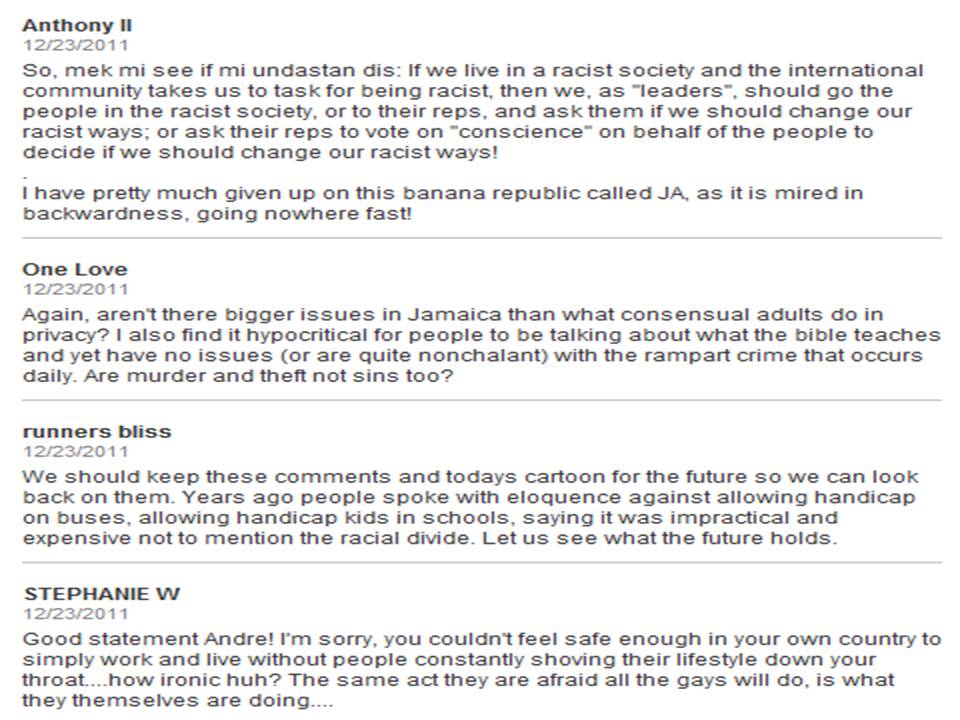


Jamaica's Reaction to Statement By Portia Simpson Miller Part VII
So the Adventists are saying that it's ok to review the bugger law, but there will be a problem if it is repealed?
I wonder what is their understanding of review the law?
The following was taken from the Jamaica Observer
Adventists say no problem with buggery law review, but...
Director of communication, public affairs and religious liberty for the Jamaica Union Conference of Seventh-day Adventists, Nigel Coke, has clarified a statement made in yesterday's edition of the Observer that the church rejected the promise made by Opposition Leader and People's National Party President Portia Simpson Miller to review the buggery law should her party come to power.
He said the church does not have a problem with a review of the buggery law, since it does not mean there will be a change to the legislation. However, he said the church would voice its concerns if the law is repealed or changed.
Read more: http://www.jamaicaobserver.com/news/Adventists-say-no-problem-with-buggery-law-review--but---_10447231#ixzz1hPRp70DI
Jamaica's Reaction to Statement By Portia Simpson Miller Part V
Apparently the rights to freedom of expression, thought and conscience must not be tolerated. The following was posted by Wayne West of the Isaachar Foundation in the Jamaica Observer.
Why a conscience vote on sodomy, Mrs Simpson Miller?
Dear Editor,
Baggaley et al of the Department of Infectious Disease Epidemiology, MRC Centre for Outbreak Analysis and Modelling, Faculty of Medicine, Imperial College London, Paddington, London, UK, reporting in the International Journal of Epidemiology of August 2010 in the article: "HIV transmission risk through anal intercourse: systematic review, meta-analysis and implications for HIV prevention", stated that among both heterosexuals and homosexuals, "Unprotected anal intercourse is a high-risk practice for HIV transmission".
Also, local media reported that the Jamaican Government found it necessary to set aside a total of some J$594 million for HIV prevention during the 2009 to 2010 and 2010 to 2011 fiscal years.
In light of this data, why would Mrs Simpson Miller consider bringing the decriminalisation of sodomy to a conscience vote ?
Wayne West
Kgn 6
wayne_west@hotmail.com
Read more: http://www.jamaicaobserver.com/letters/Why-a-conscience-vote-on-sodomy--Mrs-Simpson-Miller-_10446103#ixzz1hORvg700
Jamaica's Reaction to Statement By Portia Simpson Miller Part IV
The following is an article submitted to the Letters to the Editor in the Jamaica Gleaner. It was written by Yvonne McCalla Sobers (Families Against State Terrorism).
Impressed With Portia
THE EDITOR, Sir:
In the December 20 leadership debate, Portia Simpson Miller impressed me with her courage and her willingness to acknowledge human rights as inclusive of all, regardless of sexual orientation. I also took seriously her commitment to inclusive governance with a team approach and with citizen participation.
Andrew Holness, on the other hand, seemed prepared to deny human rights to some persons, based on their sexual orientation. He seemed keen to distance himself from his team, claiming to be on the periphery when Dudus-Manatt decisions were made, or projecting himself as the one who will deliver change.
In the debate, Andrew seemed the more sophisticated, and Portia seemed the more sincere. Recent experience with politicians has caused me to favour sincerity over eloquence.
At the constituency level, André Hylton, the PNP candidate, has proven accessible and responsive to my concerns and my suggestions for constituency governance. The new JLP candidate has not.
But my vote comes with a price. I expect the party/candidate I vote for to provide in return:
Courage to take hard decisions;
Respect for the human rights of all;
Responsiveness to citizens in and out of election time, even/especially when views are critical; and
Adoption of a team approach.
YVONNE MCCALLA SOBERS
sobersy@yahoo.com
Impressed With Portia
THE EDITOR, Sir:
In the December 20 leadership debate, Portia Simpson Miller impressed me with her courage and her willingness to acknowledge human rights as inclusive of all, regardless of sexual orientation. I also took seriously her commitment to inclusive governance with a team approach and with citizen participation.
Andrew Holness, on the other hand, seemed prepared to deny human rights to some persons, based on their sexual orientation. He seemed keen to distance himself from his team, claiming to be on the periphery when Dudus-Manatt decisions were made, or projecting himself as the one who will deliver change.
In the debate, Andrew seemed the more sophisticated, and Portia seemed the more sincere. Recent experience with politicians has caused me to favour sincerity over eloquence.
At the constituency level, André Hylton, the PNP candidate, has proven accessible and responsive to my concerns and my suggestions for constituency governance. The new JLP candidate has not.
But my vote comes with a price. I expect the party/candidate I vote for to provide in return:
Courage to take hard decisions;
Respect for the human rights of all;
Responsiveness to citizens in and out of election time, even/especially when views are critical; and
Adoption of a team approach.
YVONNE MCCALLA SOBERS
sobersy@yahoo.com
Jamaica's Reaction to Statement By Portia Simpson Miller Part III
The following article, comes from the Jamaica Gleaner, and was written by Erica Virtue
Vaz Says Constituents Stand Firm Against Homosexuality

A JLP supporter with a giant bell in St Mary on Wednesday night. - Photos by Gladstone Taylor/Photographer
Erica Virtue, Senior Gleaner Writer
With the issue of gay rights being moved to the centre of the election campaign, Jamaica Labour Party (JLP) candidate for West Portland, Daryl Vaz, on Wednesday night told a party mass rally in St Mary that his constituents have already told him to say no to the repealing of the buggery law.
Addressing thousands of Labourites in the seaside town of Annotto Bay, Vaz poured scorn on comments by People's National Party (PNP) President Portia Simpson Miller during the national leadership debate with JLP Leader Andrew Holness on Tuesday.
Simpson Miller, in her rebuttal to a question of whether homosexuals would be excluded from the Cabinet, said the issue was one of human rights, and her party would not reject anyone based on their sexual orientation. She said should the PNP be returned to power, Parliament would initiate discussion on the buggery law in Jamaica with a conscience vote on whether it should be repealed.
But Vaz claimed the people of his West Portland constituency had already spoken on the matter.
"We don't buy number two inna Cash Pot," said Vaz, in a reference to the popular game of chance in which the number two is used by some persons to refer to homosexuals.
According to Vaz, while he was willing to participate in any debate on gay rights, his response is a foregone conclusion.
"God made Adam and Eve and not Adam and Steve," Vaz said as Labourites cheered and shouted anti-gay slurs.
The issue of homosexuality has been on the JLP election platform even before it was raised as a question in the debate Tuesday night.
In Gordon Town, St Andrew, last Sunday, JLP deputy leader and the party's candidate for Western Kingston, Desmond McKenzie, declared "fire bun", following strains from the popular dancehall song which has a line "dem a par inna chi chi man car".
Also, at a recent meeting in St Elizabeth, persons on the JLP platform made reference to their love for "boonoonoonus" women, a claim that sparked a backlash from women's groups.
Former JLP leader and then Prime Minister Bruce Golding had declared an in interview on the BBC that no gay men would be allowed to serve in his Cabinet.
On Tuesday, Holness, did not articulate a clear position when questioned on the issue but implied that he would not fly in the face of popular opinion opposed to gay rights.
In recent months, several countries, which are aid donors to Jamaica, have suggested that they might change their position if more was not done to protect the rights of homosexuals.
Jamaica's Reaction to Statement By Portia Simpson Miller Part II
I've been trying to decide how to keep my readers up to speed with what is happening following Portia Simpson Miller's [personal] statement that gays can serve in her cabinet (read it here: Simpson Miller Gays can serve in my cabinet (Jamaica Election Debates 2011- Leadership ). I've decided that until I sit and put my thoughts together I'll keep you updated by reposting news articles, other blogs, videos, and comments (Jamaica's Reaction to Statement By Portia Simpson Miller (Gays can serve in my cabinet) Pt I).
So let's get started.
The following was taken from the Jamaica Observer.
Read more: http://www.jamaicaobserver.com/news/Many-Jamaicans-against-Buggery-Law-review_10447168#ixzz1hNcbo3dI
So let's get started.
The following was taken from the Jamaica Observer.
‘Idiot plan that!’ - Many Jamaicans against Buggery Law Review
THE pronouncement by Opposition Leader and People’s National Party (PNP) President Portia Simpson Miller during Tuesday night’s national leadership debate that a PNP government led by her would review the buggery law has set off a heated debate with many Jamaicans as well as some churches voicing strong opposition to any such move.
Observer staff reporter Kimmo Matthews yesterday sought the opinions of members of the public on Simpson Miller’s position.
 (L-R) ‘Rastaman’, Judith Brown White and Chevan Brown 1/3 (L-R) ‘Rastaman’, Judith Brown White and Chevan Brown 1/3 |
‘Rastaman’
It is something that I would have to go think about, as I do not want to jump to any conclusion on what was said.
Judith Brown White: Supermarket Sales Rep
I have a problem with that decision. To carry out such a review is totally wrong. What it is promoting is totally against the teachings of the Bible.
Chevan Brown
I think it was a ploy to get votes.
Delroy Mitchell
It has been happening, not here in Jamaica only, and soon or later we are going to have to take a stance. I believe that the rights of citizens should be recognised.
Devon Campbell: Taxi Operator
Not in my cabinet! If a man a deal with him thing, mek him deal with it one side. So that means sooner or later, with this review of the law, my grandchildren can’t walk in peace.
Hubert Palmer: Security guard
We are to stop trying to put a pretty coating on the issue. That sort of practice should not be tolerated. What sort of message will that send to my little son down the road?
Chairmaine Mundle: Supermarket Sales Rep
That should never be allowed to happen. God has never created people to operate and entertain that sort of practice. Our country has a strong Christian faith and belief and that sort of practice should not be encouraged and that is what such a planned review will do.
‘Businesswoman’
Our source is God. Why are we trying to sell our souls for the almighty dollar? Jamaica is not a country that embraces that sort of practice. She is out of her cotton-picking mind and she should not sell her soul for the dollar.
Ian
It is full time we should try to move away from that sort of primitive approach and allow people to live their lives despite of their sexual orientation.
Richardo Wedderburn: Security Guard
She should have tried to come up with some different approach. I know because she is a woman she a go try balance the thing. But I believe a revision of such laws is going to affect us down the road.
Jonelle Jefferson: Secretary
I do not care what a man or woman wants to do with their life, but the Opposition needs to realise that it is Jamaica we are living in and we are not going to change our views and I think it is going to hurt her chances in the upcoming election.
Orlando Gayle: Security Guard
That is totally unacceptable. Such practice and support of such practice cannot be right at all. We burn that sort of practice. Her move or plans to review the law will certainly help to promote such practice.
Toney Bromwell: Taxi Operator
Idiot plan that. Jamaica no deal with that. A vote me feel she a look.
Read more: http://www.jamaicaobserver.com/news/Many-Jamaicans-against-Buggery-Law-review_10447168#ixzz1hNcbo3dI
Friday, December 9, 2011
Transcript: Secretary Clinton – “Free And Equal In Dignity And Rights”
Geneva — December 6, 2011
Good evening, and let me express my deep honor and pleasure at being here. I want to thank Director General Tokayev and Ms. Wyden along with other ministers, ambassadors, excellencies, and UN partners. This weekend, we will celebrate Human Rights Day, the anniversary of one of the great accomplishments of the last century.
Beginning in 1947, delegates from six continents devoted themselves to drafting a declaration that would enshrine the fundamental rights and freedoms of people everywhere. In the aftermath of World War II, many nations pressed for a statement of this kind to help ensure that we would prevent future atrocities and protect the inherent humanity and dignity of all people. And so the delegates went to work. They discussed, they wrote, they revisited, revised, rewrote, for thousands of hours. And they incorporated suggestions and revisions from governments, organizations, and individuals around the world.
At three o’clock in the morning on December 10th, 1948, after nearly two years of drafting and one last long night of debate, the president of the UN General Assembly called for a vote on the final text. Forty-eight nations voted in favor; eight abstained; none dissented. And the Universal Declaration of Human Rights was adopted. It proclaims a simple, powerful idea: All human beings are born free and equal in dignity and rights. And with the declaration, it was made clear that rights are not conferred by government; they are the birthright of all people. It does not matter what country we live in, who our leaders are, or even who we are. Because we are human, we therefore have rights. And because we have rights, governments are bound to protect them.
In the 63 years since the declaration was adopted, many nations have made great progress in making human rights a human reality. Step by step, barriers that once prevented people from enjoying the full measure of liberty, the full experience of dignity, and the full benefits of humanity have fallen away. In many places, racist laws have been repealed, legal and social practices that relegated women to second-class status have been abolished, the ability of religious minorities to practice their faith freely has been secured.
In most cases, this progress was not easily won. People fought and organized and campaigned in public squares and private spaces to change not only laws, but hearts and minds. And thanks to that work of generations, for millions of individuals whose lives were once narrowed by injustice, they are now able to live more freely and to participate more fully in the political, economic, and social lives of their communities.
Now, there is still, as you all know, much more to be done to secure that commitment, that reality, and progress for all people. Today, I want to talk about the work we have left to do to protect one group of people whose human rights are still denied in too many parts of the world today. In many ways, they are an invisible minority. They are arrested, beaten, terrorized, even executed. Many are treated with contempt and violence by their fellow citizens while authorities empowered to protect them look the other way or, too often, even join in the abuse. They are denied opportunities to work and learn, driven from their homes and countries, and forced to suppress or deny who they are to protect themselves from harm.
I am talking about gay, lesbian, bisexual, and transgender people, human beings born free and given bestowed equality and dignity, who have a right to claim that, which is now one of the remaining human rights challenges of our time. I speak about this subject knowing that my own country’s record on human rights for gay people is far from perfect. Until 2003, it was still a crime in parts of our country. Many LGBT Americans have endured violence and harassment in their own lives, and for some, including many young people, bullying and exclusion are daily experiences. So we, like all nations, have more work to do to protect human rights at home.
Now, raising this issue, I know, is sensitive for many people and that the obstacles standing in the way of protecting the human rights of LGBT people rest on deeply held personal, political, cultural, and religious beliefs. So I come here before you with respect, understanding, and humility. Even though progress on this front is not easy, we cannot delay acting. So in that spirit, I want to talk about the difficult and important issues we must address together to reach a global consensus that recognizes the human rights of LGBT citizens everywhere.
The first issue goes to the heart of the matter. Some have suggested that gay rights and human rights are separate and distinct; but, in fact, they are one and the same. Now, of course, 60 years ago, the governments that drafted and passed the Universal Declaration of Human Rights were not thinking about how it applied to the LGBT community. They also weren’t thinking about how it applied to indigenous people or children or people with disabilities or other marginalized groups. Yet in the past 60 years, we have come to recognize that members of these groups are entitled to the full measure of dignity and rights, because, like all people, they share a common humanity.
This recognition did not occur all at once. It evolved over time. And as it did, we understood that we were honoring rights that people always had, rather than creating new or special rights for them. Like being a woman, like being a racial, religious, tribal, or ethnic minority, being LGBT does not make you less human. And that is why gay rights are human rights, and human rights are gay rights.
It is violation of human rights when people are beaten or killed because of their sexual orientation, or because they do not conform to cultural norms about how men and women should look or behave. It is a violation of human rights when governments declare it illegal to be gay, or allow those who harm gay people to go unpunished. It is a violation of human rights when lesbian or transgendered women are subjected to so-called corrective rape, or forcibly subjected to hormone treatments, or when people are murdered after public calls for violence toward gays, or when they are forced to flee their nations and seek asylum in other lands to save their lives. And it is a violation of human rights when life-saving care is withheld from people because they are gay, or equal access to justice is denied to people because they are gay, or public spaces are out of bounds to people because they are gay. No matter what we look like, where we come from, or who we are, we are all equally entitled to our human rights and dignity.
The second issue is a question of whether homosexuality arises from a particular part of the world. Some seem to believe it is a Western phenomenon, and therefore people outside the West have grounds to reject it. Well, in reality, gay people are born into and belong to every society in the world. They are all ages, all races, all faiths; they are doctors and teachers, farmers and bankers, soldiers and athletes; and whether we know it, or whether we acknowledge it, they are our family, our friends, and our neighbors.
Being gay is not a Western invention; it is a human reality. And protecting the human rights of all people, gay or straight, is not something that only Western governments do. South Africa’s constitution, written in the aftermath of Apartheid, protects the equality of all citizens, including gay people. In Colombia and Argentina, the rights of gays are also legally protected. In Nepal, the supreme court has ruled that equal rights apply to LGBT citizens. The Government of Mongolia has committed to pursue new legislation that will tackle anti-gay discrimination.
Now, some worry that protecting the human rights of the LGBT community is a luxury that only wealthy nations can afford. But in fact, in all countries, there are costs to not protecting these rights, in both gay and straight lives lost to disease and violence, and the silencing of voices and views that would strengthen communities, in ideas never pursued by entrepreneurs who happen to be gay. Costs are incurred whenever any group is treated as lesser or the other, whether they are women, racial, or religious minorities, or the LGBT. Former President Mogae of Botswana pointed out recently that for as long as LGBT people are kept in the shadows, there cannot be an effective public health program to tackle HIV and AIDS. Well, that holds true for other challenges as well.
The third, and perhaps most challenging, issue arises when people cite religious or cultural values as a reason to violate or not to protect the human rights of LGBT citizens. This is not unlike the justification offered for violent practices towards women like honor killings, widow burning, or female genital mutilation. Some people still defend those practices as part of a cultural tradition. But violence toward women isn’t cultural; it’s criminal. Likewise with slavery, what was once justified as sanctioned by God is now properly reviled as an unconscionable violation of human rights.
In each of these cases, we came to learn that no practice or tradition trumps the human rights that belong to all of us. And this holds true for inflicting violence on LGBT people, criminalizing their status or behavior, expelling them from their families and communities, or tacitly or explicitly accepting their killing.
Of course, it bears noting that rarely are cultural and religious traditions and teachings actually in conflict with the protection of human rights. Indeed, our religion and our culture are sources of compassion and inspiration toward our fellow human beings. It was not only those who’ve justified slavery who leaned on religion, it was also those who sought to abolish it. And let us keep in mind that our commitments to protect the freedom of religion and to defend the dignity of LGBT people emanate from a common source. For many of us, religious belief and practice is a vital source of meaning and identity, and fundamental to who we are as people. And likewise, for most of us, the bonds of love and family that we forge are also vital sources of meaning and identity. And caring for others is an expression of what it means to be fully human. It is because the human experience is universal that human rights are universal and cut across all religions and cultures.
The fourth issue is what history teaches us about how we make progress towards rights for all. Progress starts with honest discussion. Now, there are some who say and believe that all gay people are pedophiles, that homosexuality is a disease that can be caught or cured, or that gays recruit others to become gay. Well, these notions are simply not true. They are also unlikely to disappear if those who promote or accept them are dismissed out of hand rather than invited to share their fears and concerns. No one has ever abandoned a belief because he was forced to do so.
Universal human rights include freedom of expression and freedom of belief, even if our words or beliefs denigrate the humanity of others. Yet, while we are each free to believe whatever we choose, we cannot do whatever we choose, not in a world where we protect the human rights of all.
Reaching understanding of these issues takes more than speech. It does take a conversation. In fact, it takes a constellation of conversations in places big and small. And it takes a willingness to see stark differences in belief as a reason to begin the conversation, not to avoid it.
But progress comes from changes in laws. In many places, including my own country, legal protections have preceded, not followed, broader recognition of rights. Laws have a teaching effect. Laws that discriminate validate other kinds of discrimination. Laws that require equal protections reinforce the moral imperative of equality. And practically speaking, it is often the case that laws must change before fears about change dissipate.
Many in my country thought that President Truman was making a grave error when he ordered the racial desegregation of our military. They argued that it would undermine unit cohesion. And it wasn’t until he went ahead and did it that we saw how it strengthened our social fabric in ways even the supporters of the policy could not foresee. Likewise, some worried in my country that the repeal of “Don’t Ask, Don’t Tell” would have a negative effect on our armed forces. Now, the Marine Corps Commandant, who was one of the strongest voices against the repeal, says that his concerns were unfounded and that the Marines have embraced the change.
Finally, progress comes from being willing to walk a mile in someone else’s shoes. We need to ask ourselves, “How would it feel if it were a crime to love the person I love? How would it feel to be discriminated against for something about myself that I cannot change?” This challenge applies to all of us as we reflect upon deeply held beliefs, as we work to embrace tolerance and respect for the dignity of all persons, and as we engage humbly with those with whom we disagree in the hope of creating greater understanding.
A fifth and final question is how we do our part to bring the world to embrace human rights for all people including LGBT people. Yes, LGBT people must help lead this effort, as so many of you are. Their knowledge and experiences are invaluable and their courage inspirational. We know the names of brave LGBT activists who have literally given their lives for this cause, and there are many more whose names we will never know. But often those who are denied rights are least empowered to bring about the changes they seek. Acting alone, minorities can never achieve the majorities necessary for political change.
So when any part of humanity is sidelined, the rest of us cannot sit on the sidelines. Every time a barrier to progress has fallen, it has taken a cooperative effort from those on both sides of the barrier. In the fight for women’s rights, the support of men remains crucial. The fight for racial equality has relied on contributions from people of all races. Combating Islamaphobia or anti-Semitism is a task for people of all faiths. And the same is true with this struggle for equality.
Conversely, when we see denials and abuses of human rights and fail to act, that sends the message to those deniers and abusers that they won’t suffer any consequences for their actions, and so they carry on. But when we do act, we send a powerful moral message. Right here in Geneva, the international community acted this year to strengthen a global consensus around the human rights of LGBT people. At the Human Rights Council in March, 85 countries from all regions supported a statement calling for an end to criminalization and violence against people because of their sexual orientation and gender identity.
At the following session of the Council in June, South Africa took the lead on a resolution about violence against LGBT people. The delegation from South Africa spoke eloquently about their own experience and struggle for human equality and its indivisibility. When the measure passed, it became the first-ever UN resolution recognizing the human rights of gay people worldwide. In the Organization of American States this year, the Inter-American Commission on Human Rights created a unit on the rights of LGBT people, a step toward what we hope will be the creation of a special rapporteur.
Now, we must go further and work here and in every region of the world to galvanize more support for the human rights of the LGBT community. To the leaders of those countries where people are jailed, beaten, or executed for being gay, I ask you to consider this: Leadership, by definition, means being out in front of your people when it is called for. It means standing up for the dignity of all your citizens and persuading your people to do the same. It also means ensuring that all citizens are treated as equals under your laws, because let me be clear – I am not saying that gay people can’t or don’t commit crimes. They can and they do, just like straight people. And when they do, they should be held accountable, but it should never be a crime to be gay.
And to people of all nations, I say supporting human rights is your responsibility too. The lives of gay people are shaped not only by laws, but by the treatment they receive every day from their families, from their neighbors. Eleanor Roosevelt, who did so much to advance human rights worldwide, said that these rights begin in the small places close to home – the streets where people live, the schools they attend, the factories, farms, and offices where they work. These places are your domain. The actions you take, the ideals that you advocate, can determine whether human rights flourish where you are.
And finally, to LGBT men and women worldwide, let me say this: Wherever you live and whatever the circumstances of your life, whether you are connected to a network of support or feel isolated and vulnerable, please know that you are not alone. People around the globe are working hard to support you and to bring an end to the injustices and dangers you face. That is certainly true for my country. And you have an ally in the United States of America and you have millions of friends among the American people.
The Obama Administration defends the human rights of LGBT people as part of our comprehensive human rights policy and as a priority of our foreign policy. In our embassies, our diplomats are raising concerns about specific cases and laws, and working with a range of partners to strengthen human rights protections for all. In Washington, we have created a task force at the State Department to support and coordinate this work. And in the coming months, we will provide every embassy with a toolkit to help improve their efforts. And we have created a program that offers emergency support to defenders of human rights for LGBT people.
This morning, back in Washington, President Obama put into place the first U.S. Government strategy dedicated to combating human rights abuses against LGBT persons abroad. Building on efforts already underway at the State Department and across the government, the President has directed all U.S. Government agencies engaged overseas to combat the criminalization of LGBT status and conduct, to enhance efforts to protect vulnerable LGBT refugees and asylum seekers, to ensure that our foreign assistance promotes the protection of LGBT rights, to enlist international organizations in the fight against discrimination, and to respond swiftly to abuses against LGBT persons.
I am also pleased to announce that we are launching a new Global Equality Fund that will support the work of civil society organizations working on these issues around the world. This fund will help them record facts so they can target their advocacy, learn how to use the law as a tool, manage their budgets, train their staffs, and forge partnerships with women’s organizations and other human rights groups. We have committed more than $3 million to start this fund, and we have hope that others will join us in supporting it.
The women and men who advocate for human rights for the LGBT community in hostile places, some of whom are here today with us, are brave and dedicated, and deserve all the help we can give them. We know the road ahead will not be easy. A great deal of work lies before us. But many of us have seen firsthand how quickly change can come. In our lifetimes, attitudes toward gay people in many places have been transformed. Many people, including myself, have experienced a deepening of our own convictions on this topic over the years, as we have devoted more thought to it, engaged in dialogues and debates, and established personal and professional relationships with people who are gay.
This evolution is evident in many places. To highlight one example, the Delhi High Court decriminalized homosexuality in India two years ago, writing, and I quote, “If there is one tenet that can be said to be an underlying theme of the Indian constitution, it is inclusiveness.” There is little doubt in my mind that support for LGBT human rights will continue to climb. Because for many young people, this is simple: All people deserve to be treated with dignity and have their human rights respected, no matter who they are or whom they love.
There is a phrase that people in the United States invoke when urging others to support human rights: “Be on the right side of history.” The story of the United States is the story of a nation that has repeatedly grappled with intolerance and inequality. We fought a brutal civil war over slavery. People from coast to coast joined in campaigns to recognize the rights of women, indigenous peoples, racial minorities, children, people with disabilities, immigrants, workers, and on and on. And the march toward equality and justice has continued. Those who advocate for expanding the circle of human rights were and are on the right side of history, and history honors them. Those who tried to constrict human rights were wrong, and history reflects that as well.
I know that the thoughts I’ve shared today involve questions on which opinions are still evolving. As it has happened so many times before, opinion will converge once again with the truth, the immutable truth, that all persons are created free and equal in dignity and rights. We are called once more to make real the words of the Universal Declaration. Let us answer that call. Let us be on the right side of history, for our people, our nations, and future generations, whose lives will be shaped by the work we do today. I come before you with great hope and confidence that no matter how long the road ahead, we will travel it successfully together. Thank you very much. (Applause.)
Good evening, and let me express my deep honor and pleasure at being here. I want to thank Director General Tokayev and Ms. Wyden along with other ministers, ambassadors, excellencies, and UN partners. This weekend, we will celebrate Human Rights Day, the anniversary of one of the great accomplishments of the last century.
Beginning in 1947, delegates from six continents devoted themselves to drafting a declaration that would enshrine the fundamental rights and freedoms of people everywhere. In the aftermath of World War II, many nations pressed for a statement of this kind to help ensure that we would prevent future atrocities and protect the inherent humanity and dignity of all people. And so the delegates went to work. They discussed, they wrote, they revisited, revised, rewrote, for thousands of hours. And they incorporated suggestions and revisions from governments, organizations, and individuals around the world.
At three o’clock in the morning on December 10th, 1948, after nearly two years of drafting and one last long night of debate, the president of the UN General Assembly called for a vote on the final text. Forty-eight nations voted in favor; eight abstained; none dissented. And the Universal Declaration of Human Rights was adopted. It proclaims a simple, powerful idea: All human beings are born free and equal in dignity and rights. And with the declaration, it was made clear that rights are not conferred by government; they are the birthright of all people. It does not matter what country we live in, who our leaders are, or even who we are. Because we are human, we therefore have rights. And because we have rights, governments are bound to protect them.
In the 63 years since the declaration was adopted, many nations have made great progress in making human rights a human reality. Step by step, barriers that once prevented people from enjoying the full measure of liberty, the full experience of dignity, and the full benefits of humanity have fallen away. In many places, racist laws have been repealed, legal and social practices that relegated women to second-class status have been abolished, the ability of religious minorities to practice their faith freely has been secured.
In most cases, this progress was not easily won. People fought and organized and campaigned in public squares and private spaces to change not only laws, but hearts and minds. And thanks to that work of generations, for millions of individuals whose lives were once narrowed by injustice, they are now able to live more freely and to participate more fully in the political, economic, and social lives of their communities.
Now, there is still, as you all know, much more to be done to secure that commitment, that reality, and progress for all people. Today, I want to talk about the work we have left to do to protect one group of people whose human rights are still denied in too many parts of the world today. In many ways, they are an invisible minority. They are arrested, beaten, terrorized, even executed. Many are treated with contempt and violence by their fellow citizens while authorities empowered to protect them look the other way or, too often, even join in the abuse. They are denied opportunities to work and learn, driven from their homes and countries, and forced to suppress or deny who they are to protect themselves from harm.
I am talking about gay, lesbian, bisexual, and transgender people, human beings born free and given bestowed equality and dignity, who have a right to claim that, which is now one of the remaining human rights challenges of our time. I speak about this subject knowing that my own country’s record on human rights for gay people is far from perfect. Until 2003, it was still a crime in parts of our country. Many LGBT Americans have endured violence and harassment in their own lives, and for some, including many young people, bullying and exclusion are daily experiences. So we, like all nations, have more work to do to protect human rights at home.
Now, raising this issue, I know, is sensitive for many people and that the obstacles standing in the way of protecting the human rights of LGBT people rest on deeply held personal, political, cultural, and religious beliefs. So I come here before you with respect, understanding, and humility. Even though progress on this front is not easy, we cannot delay acting. So in that spirit, I want to talk about the difficult and important issues we must address together to reach a global consensus that recognizes the human rights of LGBT citizens everywhere.
The first issue goes to the heart of the matter. Some have suggested that gay rights and human rights are separate and distinct; but, in fact, they are one and the same. Now, of course, 60 years ago, the governments that drafted and passed the Universal Declaration of Human Rights were not thinking about how it applied to the LGBT community. They also weren’t thinking about how it applied to indigenous people or children or people with disabilities or other marginalized groups. Yet in the past 60 years, we have come to recognize that members of these groups are entitled to the full measure of dignity and rights, because, like all people, they share a common humanity.
This recognition did not occur all at once. It evolved over time. And as it did, we understood that we were honoring rights that people always had, rather than creating new or special rights for them. Like being a woman, like being a racial, religious, tribal, or ethnic minority, being LGBT does not make you less human. And that is why gay rights are human rights, and human rights are gay rights.
It is violation of human rights when people are beaten or killed because of their sexual orientation, or because they do not conform to cultural norms about how men and women should look or behave. It is a violation of human rights when governments declare it illegal to be gay, or allow those who harm gay people to go unpunished. It is a violation of human rights when lesbian or transgendered women are subjected to so-called corrective rape, or forcibly subjected to hormone treatments, or when people are murdered after public calls for violence toward gays, or when they are forced to flee their nations and seek asylum in other lands to save their lives. And it is a violation of human rights when life-saving care is withheld from people because they are gay, or equal access to justice is denied to people because they are gay, or public spaces are out of bounds to people because they are gay. No matter what we look like, where we come from, or who we are, we are all equally entitled to our human rights and dignity.
The second issue is a question of whether homosexuality arises from a particular part of the world. Some seem to believe it is a Western phenomenon, and therefore people outside the West have grounds to reject it. Well, in reality, gay people are born into and belong to every society in the world. They are all ages, all races, all faiths; they are doctors and teachers, farmers and bankers, soldiers and athletes; and whether we know it, or whether we acknowledge it, they are our family, our friends, and our neighbors.
Being gay is not a Western invention; it is a human reality. And protecting the human rights of all people, gay or straight, is not something that only Western governments do. South Africa’s constitution, written in the aftermath of Apartheid, protects the equality of all citizens, including gay people. In Colombia and Argentina, the rights of gays are also legally protected. In Nepal, the supreme court has ruled that equal rights apply to LGBT citizens. The Government of Mongolia has committed to pursue new legislation that will tackle anti-gay discrimination.
Now, some worry that protecting the human rights of the LGBT community is a luxury that only wealthy nations can afford. But in fact, in all countries, there are costs to not protecting these rights, in both gay and straight lives lost to disease and violence, and the silencing of voices and views that would strengthen communities, in ideas never pursued by entrepreneurs who happen to be gay. Costs are incurred whenever any group is treated as lesser or the other, whether they are women, racial, or religious minorities, or the LGBT. Former President Mogae of Botswana pointed out recently that for as long as LGBT people are kept in the shadows, there cannot be an effective public health program to tackle HIV and AIDS. Well, that holds true for other challenges as well.
The third, and perhaps most challenging, issue arises when people cite religious or cultural values as a reason to violate or not to protect the human rights of LGBT citizens. This is not unlike the justification offered for violent practices towards women like honor killings, widow burning, or female genital mutilation. Some people still defend those practices as part of a cultural tradition. But violence toward women isn’t cultural; it’s criminal. Likewise with slavery, what was once justified as sanctioned by God is now properly reviled as an unconscionable violation of human rights.
In each of these cases, we came to learn that no practice or tradition trumps the human rights that belong to all of us. And this holds true for inflicting violence on LGBT people, criminalizing their status or behavior, expelling them from their families and communities, or tacitly or explicitly accepting their killing.
Of course, it bears noting that rarely are cultural and religious traditions and teachings actually in conflict with the protection of human rights. Indeed, our religion and our culture are sources of compassion and inspiration toward our fellow human beings. It was not only those who’ve justified slavery who leaned on religion, it was also those who sought to abolish it. And let us keep in mind that our commitments to protect the freedom of religion and to defend the dignity of LGBT people emanate from a common source. For many of us, religious belief and practice is a vital source of meaning and identity, and fundamental to who we are as people. And likewise, for most of us, the bonds of love and family that we forge are also vital sources of meaning and identity. And caring for others is an expression of what it means to be fully human. It is because the human experience is universal that human rights are universal and cut across all religions and cultures.
The fourth issue is what history teaches us about how we make progress towards rights for all. Progress starts with honest discussion. Now, there are some who say and believe that all gay people are pedophiles, that homosexuality is a disease that can be caught or cured, or that gays recruit others to become gay. Well, these notions are simply not true. They are also unlikely to disappear if those who promote or accept them are dismissed out of hand rather than invited to share their fears and concerns. No one has ever abandoned a belief because he was forced to do so.
Universal human rights include freedom of expression and freedom of belief, even if our words or beliefs denigrate the humanity of others. Yet, while we are each free to believe whatever we choose, we cannot do whatever we choose, not in a world where we protect the human rights of all.
Reaching understanding of these issues takes more than speech. It does take a conversation. In fact, it takes a constellation of conversations in places big and small. And it takes a willingness to see stark differences in belief as a reason to begin the conversation, not to avoid it.
But progress comes from changes in laws. In many places, including my own country, legal protections have preceded, not followed, broader recognition of rights. Laws have a teaching effect. Laws that discriminate validate other kinds of discrimination. Laws that require equal protections reinforce the moral imperative of equality. And practically speaking, it is often the case that laws must change before fears about change dissipate.
Many in my country thought that President Truman was making a grave error when he ordered the racial desegregation of our military. They argued that it would undermine unit cohesion. And it wasn’t until he went ahead and did it that we saw how it strengthened our social fabric in ways even the supporters of the policy could not foresee. Likewise, some worried in my country that the repeal of “Don’t Ask, Don’t Tell” would have a negative effect on our armed forces. Now, the Marine Corps Commandant, who was one of the strongest voices against the repeal, says that his concerns were unfounded and that the Marines have embraced the change.
Finally, progress comes from being willing to walk a mile in someone else’s shoes. We need to ask ourselves, “How would it feel if it were a crime to love the person I love? How would it feel to be discriminated against for something about myself that I cannot change?” This challenge applies to all of us as we reflect upon deeply held beliefs, as we work to embrace tolerance and respect for the dignity of all persons, and as we engage humbly with those with whom we disagree in the hope of creating greater understanding.
A fifth and final question is how we do our part to bring the world to embrace human rights for all people including LGBT people. Yes, LGBT people must help lead this effort, as so many of you are. Their knowledge and experiences are invaluable and their courage inspirational. We know the names of brave LGBT activists who have literally given their lives for this cause, and there are many more whose names we will never know. But often those who are denied rights are least empowered to bring about the changes they seek. Acting alone, minorities can never achieve the majorities necessary for political change.
So when any part of humanity is sidelined, the rest of us cannot sit on the sidelines. Every time a barrier to progress has fallen, it has taken a cooperative effort from those on both sides of the barrier. In the fight for women’s rights, the support of men remains crucial. The fight for racial equality has relied on contributions from people of all races. Combating Islamaphobia or anti-Semitism is a task for people of all faiths. And the same is true with this struggle for equality.
Conversely, when we see denials and abuses of human rights and fail to act, that sends the message to those deniers and abusers that they won’t suffer any consequences for their actions, and so they carry on. But when we do act, we send a powerful moral message. Right here in Geneva, the international community acted this year to strengthen a global consensus around the human rights of LGBT people. At the Human Rights Council in March, 85 countries from all regions supported a statement calling for an end to criminalization and violence against people because of their sexual orientation and gender identity.
At the following session of the Council in June, South Africa took the lead on a resolution about violence against LGBT people. The delegation from South Africa spoke eloquently about their own experience and struggle for human equality and its indivisibility. When the measure passed, it became the first-ever UN resolution recognizing the human rights of gay people worldwide. In the Organization of American States this year, the Inter-American Commission on Human Rights created a unit on the rights of LGBT people, a step toward what we hope will be the creation of a special rapporteur.
Now, we must go further and work here and in every region of the world to galvanize more support for the human rights of the LGBT community. To the leaders of those countries where people are jailed, beaten, or executed for being gay, I ask you to consider this: Leadership, by definition, means being out in front of your people when it is called for. It means standing up for the dignity of all your citizens and persuading your people to do the same. It also means ensuring that all citizens are treated as equals under your laws, because let me be clear – I am not saying that gay people can’t or don’t commit crimes. They can and they do, just like straight people. And when they do, they should be held accountable, but it should never be a crime to be gay.
And to people of all nations, I say supporting human rights is your responsibility too. The lives of gay people are shaped not only by laws, but by the treatment they receive every day from their families, from their neighbors. Eleanor Roosevelt, who did so much to advance human rights worldwide, said that these rights begin in the small places close to home – the streets where people live, the schools they attend, the factories, farms, and offices where they work. These places are your domain. The actions you take, the ideals that you advocate, can determine whether human rights flourish where you are.
And finally, to LGBT men and women worldwide, let me say this: Wherever you live and whatever the circumstances of your life, whether you are connected to a network of support or feel isolated and vulnerable, please know that you are not alone. People around the globe are working hard to support you and to bring an end to the injustices and dangers you face. That is certainly true for my country. And you have an ally in the United States of America and you have millions of friends among the American people.
The Obama Administration defends the human rights of LGBT people as part of our comprehensive human rights policy and as a priority of our foreign policy. In our embassies, our diplomats are raising concerns about specific cases and laws, and working with a range of partners to strengthen human rights protections for all. In Washington, we have created a task force at the State Department to support and coordinate this work. And in the coming months, we will provide every embassy with a toolkit to help improve their efforts. And we have created a program that offers emergency support to defenders of human rights for LGBT people.
This morning, back in Washington, President Obama put into place the first U.S. Government strategy dedicated to combating human rights abuses against LGBT persons abroad. Building on efforts already underway at the State Department and across the government, the President has directed all U.S. Government agencies engaged overseas to combat the criminalization of LGBT status and conduct, to enhance efforts to protect vulnerable LGBT refugees and asylum seekers, to ensure that our foreign assistance promotes the protection of LGBT rights, to enlist international organizations in the fight against discrimination, and to respond swiftly to abuses against LGBT persons.
I am also pleased to announce that we are launching a new Global Equality Fund that will support the work of civil society organizations working on these issues around the world. This fund will help them record facts so they can target their advocacy, learn how to use the law as a tool, manage their budgets, train their staffs, and forge partnerships with women’s organizations and other human rights groups. We have committed more than $3 million to start this fund, and we have hope that others will join us in supporting it.
The women and men who advocate for human rights for the LGBT community in hostile places, some of whom are here today with us, are brave and dedicated, and deserve all the help we can give them. We know the road ahead will not be easy. A great deal of work lies before us. But many of us have seen firsthand how quickly change can come. In our lifetimes, attitudes toward gay people in many places have been transformed. Many people, including myself, have experienced a deepening of our own convictions on this topic over the years, as we have devoted more thought to it, engaged in dialogues and debates, and established personal and professional relationships with people who are gay.
This evolution is evident in many places. To highlight one example, the Delhi High Court decriminalized homosexuality in India two years ago, writing, and I quote, “If there is one tenet that can be said to be an underlying theme of the Indian constitution, it is inclusiveness.” There is little doubt in my mind that support for LGBT human rights will continue to climb. Because for many young people, this is simple: All people deserve to be treated with dignity and have their human rights respected, no matter who they are or whom they love.
There is a phrase that people in the United States invoke when urging others to support human rights: “Be on the right side of history.” The story of the United States is the story of a nation that has repeatedly grappled with intolerance and inequality. We fought a brutal civil war over slavery. People from coast to coast joined in campaigns to recognize the rights of women, indigenous peoples, racial minorities, children, people with disabilities, immigrants, workers, and on and on. And the march toward equality and justice has continued. Those who advocate for expanding the circle of human rights were and are on the right side of history, and history honors them. Those who tried to constrict human rights were wrong, and history reflects that as well.
I know that the thoughts I’ve shared today involve questions on which opinions are still evolving. As it has happened so many times before, opinion will converge once again with the truth, the immutable truth, that all persons are created free and equal in dignity and rights. We are called once more to make real the words of the Universal Declaration. Let us answer that call. Let us be on the right side of history, for our people, our nations, and future generations, whose lives will be shaped by the work we do today. I come before you with great hope and confidence that no matter how long the road ahead, we will travel it successfully together. Thank you very much. (Applause.)
Subscribe to:
Posts (Atom)
